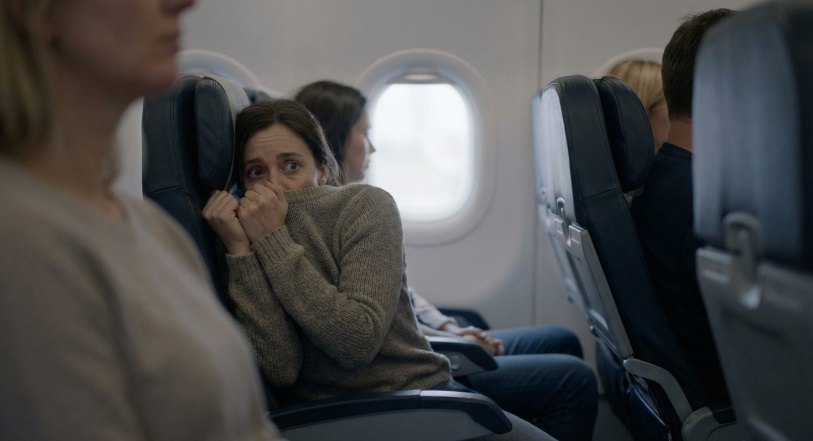
📖 Même avion. Mêmes turbulences. Deux expériences complètement différentes.
Personne A : « Oh, ça secoue un peu ! Les pilotes s'en occupent. »
Personne B : « On va s'écraser ! C'est fini ! »
Quelle est la différence ?
L'état de leur système nerveux .
C'est l'un des enseignements les plus marquants de la théorie polyvagale :
→ C'est votre état d'esprit qui détermine votre histoire. Et non l'inverse.
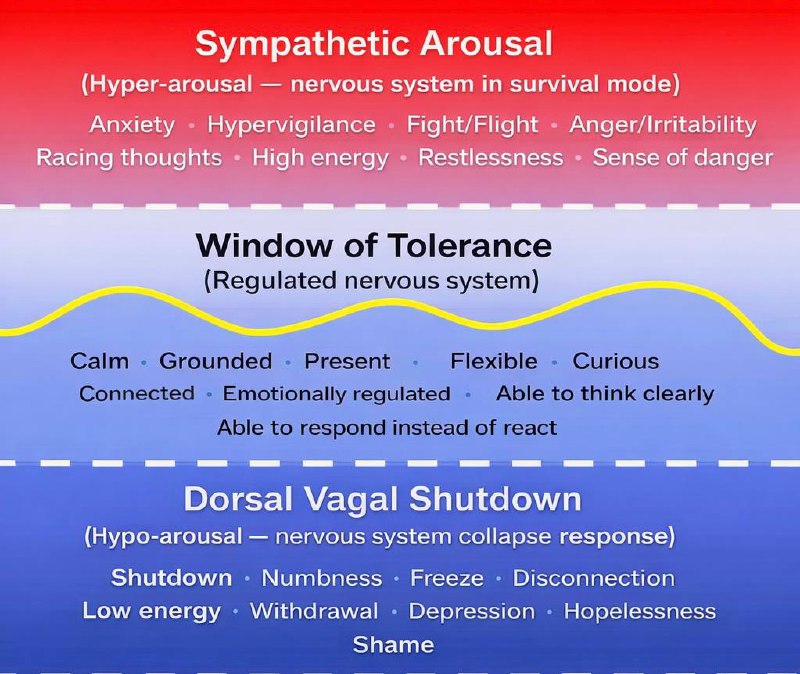
Lorsque vous êtes en mode VAGAL VENTRAL (état de sécurité) :
- Tu considères les turbulences comme quelque chose de normal
- Vous faites confiance aux pilotes
- Vous pouvez accéder à des pensées rationnelles
- Ton histoire, c'est : « C'est un peu gênant, mais ça va »
Lorsque vous êtes en mode SYMPATHIQUE (état de combat ou de fuite) :
- Tu interprètes chaque bruit comme un danger
- Tu es hypervigilant face aux menaces
- Tes pensées s'emballent et tu imagines les pires scénarios
- Votre histoire est : « Il y a quelque chose qui cloche »
Lorsque vous êtes en mode « DORSAL VAGAL » (état de blocage) :
- Vous vous sentez désespéré et isolé
- Rien n'y fait, rien n'a d'importance
- Tu te dis : « Je n'y arrive pas, je suis à bout »
La percée ?
On ne peut pas sortir d'un état nerveux par la seule force de la pensée.
Mais dès que vous CHANGEZ d'état d'esprit (même légèrement), votre histoire change automatiquement.
Voici pourquoi :
- ❌ Dire à quelqu'un « détends-toi » ne sert à rien
- ❌ Réciter des statistiques sur la sécurité ne sert à rien
- ❌ Essayer de raisonner pour chasser la peur ne marche pas
✅ Mais en régulant d'abord votre système nerveux, la situation évolue naturellement.
Deb Dana appelle cela « l'approche Story-Follow-State ».
Changez la situation → L'histoire change → L'expérience change.
Alors la prochaine fois que la panique vous envahira à 9 000 mètres d'altitude, demandez-vous :
« Dans quel état suis-je en ce moment ? »
Pas « Qu'est-ce qui ne va pas chez moi ? » Pas « Pourquoi je n'arrive pas à être normal ? »
Juste : Quel État ?
Cette simple question suffit à vous ramener vers la sécurité.