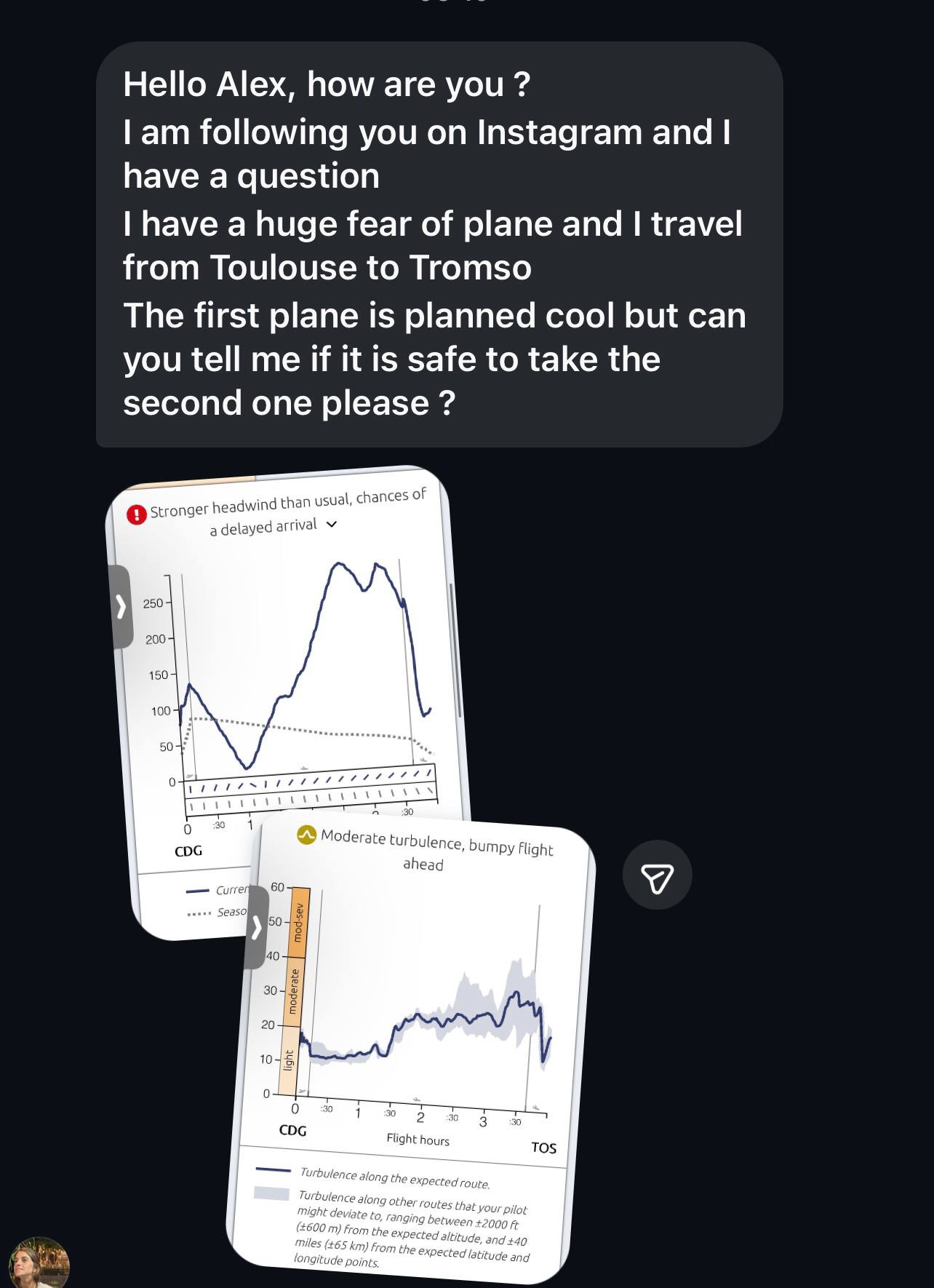
La réponse est oui et non – surtout pour les personnes anxieuses.
Oui : car l'imprévisibilité est l'un des principaux facteurs de stress pour les personnes qui ont peur de prendre l'avion. Savoir à quoi s'attendre aide à réduire l'anxiété. Les prévisions donnent un sentiment de maîtrise et atténuent cet élément d'imprévisibilité.
Non : et voici pourquoi :
La précision des prévisions reste assez faible, aux alentours de 51 à 53 %. C'est à peine mieux que de tirer à pile ou face. ⠀
Si les prévisions annoncent des turbulences « modérées » ou « fortes », vous pourriez être tenté d'annuler votre vol. Le cerveau récompense ce comportement d'évitement en libérant des substances chimiques associées au soulagement (dopamine et endorphines), vous apprenant ainsi que renoncer à prendre l'avion équivaut à se sentir mieux. Au fil du temps, ce cercle vicieux rend les voyages en avion encore plus difficiles. ⠀
Si vous ne pouvez pas annuler votre vol, vous monterez à bord déjà terrifié, dans l'attente de ces « mauvaises » turbulences – même si elles ne se produisent jamais. ⠀
Si les prévisions annoncent un « vol sans encombre », vous pourriez vous demander : « Et si elles se trompaient ? » ⠀
Et si ce n'est pas le cas – si vous sentez des secousses alors que les prévisions annonçaient un vol en douceur –, la panique s'empare de vous : « Ça ne peut pas être de la turbulence ; il doit y avoir un problème ! » ⠀
Plus vous consacrez d'énergie mentale aux prévisions, aux attentes et aux stratégies d'évitement, plus vous amplifiez l'importance de la turbulence elle-même. En réalité, la turbulence n'est qu'un mouvement : tous les moyens de transport sont soumis à des secousses. Pour un passager attaché, la turbulence est sans aucun danger. Mais en lui accordant trop d'importance, on transforme une secousse inoffensive en un monstre.
Alors, quelle est la bonne solution ?
Apprenez à faire face à tout ce qui peut arriver, au moment où cela se produit. Cela implique de comprendre non seulement la sécurité aérienne, mais aussi votre propre état d'esprit et la manière de gérer vos réactions. Vous n'avez pas besoin de maîtriser les turbulences ; vous devez maîtriser votre esprit et votre corps face à elles.
À long terme, les prévisions de turbulences peuvent, à elles seules, faire plus de mal que de bien à une personne souffrant d'anxiété en avion. La prévisibilité est utile, mais uniquement dans le cadre d'un ensemble d'outils complet et structuré permettant de gérer la peur.
C'est exactement ce que fait l'application SkyGuru. Elle propose des prévisions de turbulences, mais met également à la disposition des passagers anxieux divers outils psychologiques. Elle aide ces derniers à faire face aux turbulences non pas en les évitant, mais en apprenant à gérer leur système nerveux lorsque des turbulences externes (ou internes) surviennent.